
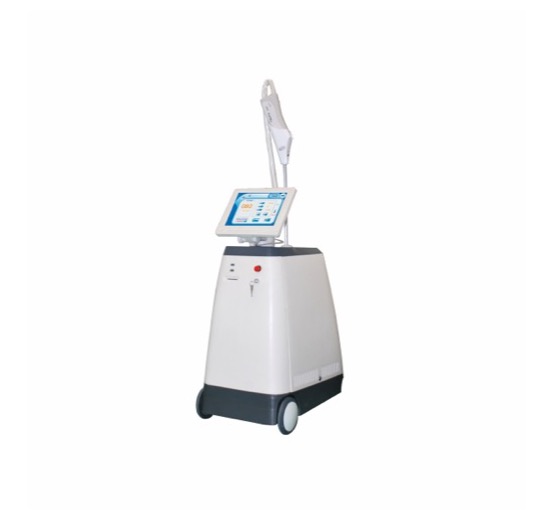
For permanent hair reduction, 808nm diode laser is the best all-around wavelength for most clinics. It strikes the optimal balance between melanin absorption and penetration depth, works safely across Fitzpatrick skin types I–V, and delivers consistent results with lower pain and fewer sessions than 755nm or 1064nm. Your choice should match your client demographic: 755nm for lighter skin with fine hair, 1064nm for dark skin (type V–VI), and 808nm for the broadest, most profitable patient base.
Every laser hair removal wavelength is a bet on physics. The target is melanin in the hair follicle. The problem? Melanin in the skin, too. If your wavelength absorbs too strongly in the epidermis, you get burns, blisters, and angry clients. Absorb too weakly, and the follicle never reaches damaging temperature.
The three contenders — 755nm (alexandrite), 808nm (diode), and 1064nm (Nd:YAG) — sit at different points on the melanin absorption curve. Per established selective photothermolysis principles, 755nm has the highest melanin affinity of the three, 808nm sits in the middle, and 1064nm has the lowest. That sounds simple, but depth changes everything.
Shorter wavelengths scatter more in tissue. So while 755nm grabs melanin hard, it can't reach deep follicles in thick skin. 1064nm penetrates deepest but needs more energy to compensate for weaker absorption. 808nm is the compromise that works in practice.
| Wavelength | Melanin Absorption | Penetration Depth | Best Skin Types | Pain Level |
|---|---|---|---|---|
| 755nm (Alexandrite) | High | ~2–3 mm | I–III | Moderate |
| 808nm (Diode) | Medium | ~3–5 mm | I–V | Low–Moderate |
| 1064nm (Nd:YAG) | Low | ~5–7 mm | IV–VI | High |
If your clinic sees mostly Fitzpatrick types I–III with fine, light hair, 755nm is your fastest option. Its high melanin absorption means you can use lower fluences and still get follicle destruction. The trade-off? You can't use it safely on tanned or dark skin. The risk of epidermal burn spikes fast.
Alexandrite lasers typically have larger spot sizes and higher repetition rates than diodes. That translates to faster treatment times — a full back in 20 minutes versus 30–40 with 808nm. But speed doesn't matter if you can't treat half your clients.
Where 755nm wins:
Where it falls short:
This is the wavelength you'll see in most professional hair removal machines for a reason. The 808nm diode laser sits in a sweet spot: enough melanin absorption to heat the follicle efficiently, but enough depth to reach the bulge and bulb regions where hair stem cells live. It's the most versatile choice for a clinic that can't afford to turn away clients based on skin type.
Per manufacturer specifications from Pmise engineering documentation, modern 808nm diode systems deliver fluences up to 120 J/cm² with pulse widths from 5–400 ms. That flexibility lets you treat everything from a type II blonde upper lip to a type V Brazilian. The key is the cooling system — contact sapphire cooling at –20°C to –5°C protects the epidermis while the 808nm energy passes through to the follicle.
Real-world performance: a busy salon running back-to-back sessions will find the 808nm diode handles high duty cycles without overheating. The laser bars are solid-state, meaning no flashlamps to replace every 100,000 shots like with IPL. Maintenance cost per treatment is lower over the machine's life.
When to choose 808nm:
Pmise's Diode Laser 808nm hair removal systems are built around this wavelength. They use stacked diode bars with independent cooling channels, which keeps the output stable even at high rep rates. If you're comparing specs, look for pulse energy stability — a drop of more than 10% over a session means inconsistent results.
For Fitzpatrick skin types V and VI, 1064nm is the only viable option among these three. Its low melanin absorption means the epidermis acts as a relatively clear window — the energy passes through skin pigment and hits the follicle deeper down. This is why the FDA has long recognized Nd:YAG as safe for darker skin types when used with appropriate parameters.
The drawback is real: you need higher fluences to get the same follicular heating. That means more pain. And because 1064nm has lower melanin selectivity, some of the energy is absorbed by hemoglobin and water, which can cause diffuse heating. Without proper contact cooling, you'll get erythema that takes hours to resolve.
Where 1064nm excels:
Where it's not ideal:
If you're considering adding 1064nm to your menu, look at Long Pulse ND:YAG Laser 1064nm systems. The long pulse mode (10–100 ms) is specifically designed for hair removal, as opposed to the Q-switched version used for tattoo removal. For a deeper dive on treating dark skin, read Long Pulse ND:YAG Laser for Dark Skin Hair Removal Explained.
There's no universal answer, but there's a practical one. Let's break it down by clinic profile.
| Clinic Type | Recommended Wavelength | Why |
|---|---|---|
| High-volume, general practice | 808nm Diode | Treats broadest range of skin types and hair colors. Best ROI per machine. |
| Premium, light-skinned clientele | 755nm Alexandrite | Fastest treatment times. Highest client satisfaction on fair skin. |
| Diverse urban clinic | 808nm + 1064nm | Two wavelengths cover types I–VI. Diode for light skin, Nd:YAG for dark. |
| Dark-skin specialist | 1064nm Nd:YAG | Safety first. Build reputation as the clinic that treats dark skin without burns. |
If you're buying your first machine, start with 808nm. It's the most forgiving of operator error and the most profitable across a typical client base. Read How to Choose a Diode Laser Machine: 7 Specs That Matter for a checklist on what to evaluate before you sign the purchase order.
And if you're wondering how 808nm compares to IPL — the other common hair reduction technology — see Diode Laser vs IPL Hair Removal: Which Should Clinics Buy?. The short version: laser wins for permanent results; IPL wins for lower upfront cost and versatility.
No discussion of laser hair removal wavelength is complete without addressing epidermal cooling. Every wavelength discussed here generates heat in the skin. Without active cooling, you risk burns regardless of which wavelength you choose.
Per IEC 60825, all class 4 laser systems require protective eyewear and controlled access. But the real safety factor is the cooling system. Contact sapphire cooling (chilled to –10°C to –20°C) is the gold standard for 808nm and 755nm. For 1064nm, cryogen spray or forced cold air can supplement contact cooling.
CE marking under the Medical Device Regulation (MDR) requires that manufacturers demonstrate thermal safety margins. When evaluating a machine, ask for the cooling performance data — specifically, the temperature gradient across the treatment window. Uneven cooling means uneven results.
For a full protocol on matching parameters to skin type, read Laser Hair Removal for Fitzpatrick Skin Types IV–VI: Settings. And if you're troubleshooting poor results, Why Laser Hair Removal Fails: 6 Machine & Parameter Mistakes covers the common pitfalls.
What does this guide cover?
It walks you through the three main laser hair removal wavelengths — 755nm, 808nm, and 1064nm — and helps you decide which one fits your clinic's client base and goals. You'll get the physics behind each wavelength, real-world performance notes, and a straightforward recommendation for first-time buyers.
Every Pmise machine is verified through rigorous testing. Tell us your target treatments and market.