
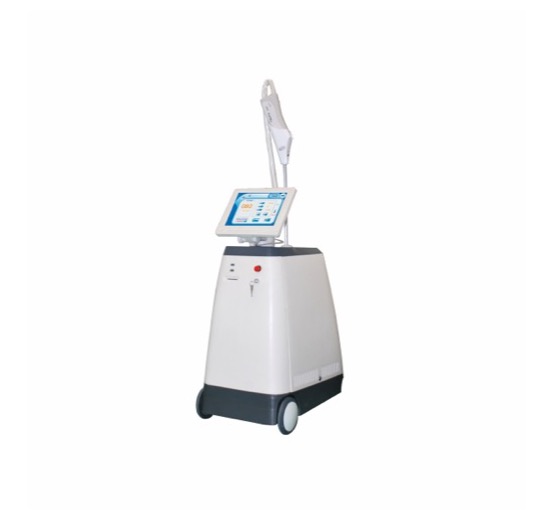
The nd:yag laser is a solid-state workhorse. Clinics rely on it daily. Its native 1064nm beam penetrates deep with low melanin absorption, which makes it safer on darker skin than shorter wavelengths. Frequency-doubling to 532nm gives you a superficial pigment and vascular tool. The two modes that actually matter? Q-switched nanosecond pulses for shattering tattoo ink, and long-pulse millisecond pulses for hair and vessels. Match pulse duration to the target's thermal relaxation time and you'll pick the right handpiece every time.
An ND:YAG laser gets its name from neodymium ions doped into a yttrium aluminum garnet crystal. Pump that crystal with a flashlamp or diode. The neodymium ions emit light. The dominant emission sits at 1064nm, in the near-infrared. Nobody picked that wavelength for cosmetic reasons. It's just the physics of the energy transition inside the neodymium ion.
So 1064nm is the native wavelength. That matters for your clinic. Why? Because 1064nm has a few useful properties. It isn't strongly absorbed by melanin in the epidermis. Or by water. Or hemoglobin. The beam travels several millimetres into skin before it dumps its energy. For a busy med-spa treating Fitzpatrick IV, V and VI patients, this is huge. Your 1064nm beam reaches deep dermal structures without cooking the surface as aggressively as shorter wavelengths do.
In practice, 1064nm is your default for hair removal on darker skin, deep vascular lesions and dermal pigmented lesions. You'll see it on long-pulse platforms for hair and veins. And on Q-switched platforms for nevus of Ota, deep tattoos and other dermal pigment.
Pass the 1064nm beam through a potassium titanyl phosphate (KTP) crystal. Something useful happens. The crystal doubles the frequency. That halves the wavelength. You get 532nm green light. Same laser, different chromophore profile.
532nm is strongly absorbed by melanin and oxyhemoglobin. So it's the right tool for superficial epidermal pigment — solar lentigines, freckles, age spots — and for superficial vascular lesions like facial telangiectasias. Red, orange and yellow tattoo inks also respond. Those often don't budge with 1064nm alone.
The trade-off is epidermal safety. 532nm loves melanin. It can overheat darker skin if you're not careful. Always pair 532nm treatments with epidermal cooling and conservative fluence on anything above Fitzpatrick III. A machine that offers both 1064nm and 532nm gives your clinic a full pigment and vascular menu from one platform.
Wavelength is only half the story. The same 1064nm beam behaves completely differently depending on how long you deliver it. That's the difference between Q-switched and long-pulse.
| Mode | Pulse duration | Primary mechanism | Main targets | Skin type notes |
|---|---|---|---|---|
| Q-switched | Nanoseconds | Photoacoustic shattering | Tattoos, dermal pigmented lesions, epidermal pigment (532nm) | 1064nm safer on darker skin; 532nm for light skin |
| Long-pulse | Milliseconds | Photothermal heating | Hair reduction, leg veins, vascular lesions, onychomycosis | 1064nm preferred for dark skin; 532nm for superficial vessels on light skin |
A Q-switch is an optical gate. It holds back the laser energy. Lets it build up. Then releases it all in a burst measured in nanoseconds. Peak power is enormous. When that short pulse hits a tattoo ink particle or a dermal melanocyte, it doesn't just heat it — it creates a shockwave that physically shatters the pigment. Pmise engineering documentation describes this as an instantaneous blast. It breaks pigment into fragments. Part of those get cleared by your patient's lymphatic system.
That photoacoustic effect is why Q-switched 1064nm is the first choice for nevus of Ota and deep tattoos. And why 532nm Q-switched handles epidermal pigment. Pulse duration matters more than average power. A 5-nanosecond pulse and a 20-nanosecond pulse are both "Q-switched." But the shorter one shatters ink more efficiently with less surrounding heat. Comparing tattoo machines? Ask about pulse width, not just maximum energy. You can see how this works on our Q-switched ND:YAG laser page. Or dig into the mechanism in our Q-switched laser technology explainer.
Long-pulse ND:YAG stretches the pulse into the millisecond range. Now the mechanism is photothermal, not photoacoustic. Your target absorbs energy and heats up gradually. For hair reduction, that target is melanin in the hair shaft and follicle. For vascular work, it's hemoglobin in the vessel wall.
Because 1064nm is weakly absorbed by epidermal melanin, a long-pulse 1064nm handpiece can treat darker skin for hair removal. Without the high burn risk you'd get from an 808nm diode or IPL. That's a distinct advantage for your clinic. Treating South Asian, Middle Eastern or African patients? You'll lean on long-pulse 1064nm heavily. The same wavelength also reaches deeper leg veins that shorter wavelengths can't touch. Some clinicians use long-pulse 1064nm for onychomycosis too. They heat the nail bed to damage fungus. It's less established than hair and vascular work, but it's a real option on many platforms. Building a hair removal menu? Our laser hair removal vs waxing article covers the business case. For the hardware itself, see the Long Pulse ND:YAG laser 1064nm.
Here's the concept that makes all of this click. Every target in skin — a tattoo ink particle, a hair follicle, a blood vessel — has a thermal relaxation time. That's the time it takes for the target to lose about half its heat to surrounding tissue. Deliver laser energy in a pulse shorter than that time. The heat stays confined to the target. Pulse longer? Heat leaks out. It damages surrounding skin.
That's selective photothermolysis in one sentence. Tattoo ink particles are tiny. Their thermal relaxation time is in the nanosecond range. So you need a nanosecond Q-switched pulse to shatter them without a big burn. Hair follicles and blood vessels are much larger. Their thermal relaxation time is in the millisecond range. Fire a nanosecond pulse at a hair follicle? You might not deliver enough thermal damage to destroy it. Fire a millisecond pulse at a tattoo particle? You'll heat the surrounding dermis long after the particle has given up its heat.
This is why buying an ND:YAG laser isn't just about wavelength. You're matching pulse duration to the target. A platform that offers both Q-switched and long-pulse heads covers both ends of the thermal relaxation spectrum. That's a more flexible asset for your clinic than two single-mode machines.
If nanoseconds are good for shattering ink, picoseconds are even better. A picosecond laser emits pulses three orders of magnitude shorter than a nanosecond laser. Peak power is higher. The photoacoustic effect is more efficient. For stubborn tattoo inks — especially colours that have been treated multiple times — picosecond can sometimes clear ink faster than nanosecond Q-switched.
Does that mean you should skip Q-switched and buy a picosecond laser? Not necessarily. Nanosecond Q-switched ND:YAG is still the workhorse for thousands of clinics. It's proven. It's less expensive. It handles a wide range of pigmented lesions beyond tattoos. Picosecond is a premium tool. It's often justified by high tattoo removal volume. Not all picosecond lasers are ND:YAG, either — many use alexandrite or other crystals. Running six tattoo removals a day? Evaluate both. If tattoo removal is one part of your broader skin clinic menu, a solid Q-switched platform likely gives you better return.
Start with your treatment menu. Do you need tattoo removal and pigmented lesions? Buy a Q-switched platform. Need hair removal on dark skin and vascular work? Buy long-pulse. Need both? Look for a multi-mode system with interchangeable heads. One console with Q-switched 1064/532 and long-pulse 1064 covers a huge range of revenue-generating treatments. Without doubling your service overhead.
Then look at cooling. Epidermal cooling is non-negotiable on 532nm for anything above Fitzpatrick III. It matters for patient comfort on all 1064nm treatments too. Contact sapphire tips, cold air or cryogen spray all work. What you don't want? A 532nm handpiece with no cooling option. And a clinic full of darker-skin patients.
Check spot size and peak power. Larger spot sizes penetrate deeper and let you treat faster. But they drop energy density unless the laser has enough power to compensate. Ask the manufacturer for a fluence chart at each spot size. No chart? That's a red flag.
Finally, verify the manufacturing basics. CE marking under the Medical Device Regulation and ISO 13485 certification are baseline expectations for a medical laser supplier. Class 4 laser safety protocols per IEC 60825 are required. If a supplier can't show you their quality system documentation, walk away. The FDA also clears ND:YAG lasers for tattoo removal and pigmented lesion treatment. That clearance should be part of your paperwork.
Is 1064nm safe for dark skin?
Safer than shorter wavelengths, yes. Its low melanin absorption means less epidermal heat and fewer burns when your settings are correct. But "safer" is not "safe without training." Dark skin still needs proper cooling and conservative fluence.
Can one ND:YAG machine do tattoo removal and hair removal?
Yes, if it has both Q-switched and long-pulse heads. The Q-switched head handles ink and pigmented lesions. The long-pulse head handles hair and vessels. A multi-mode platform gives you both without buying two machines.
What's the difference between 532nm and 1064nm for pigmentation?
532nm is strongly absorbed by epidermal melanin. So it treats superficial pigment like freckles and age spots. 1064nm penetrates deeper and treats dermal pigment like nevus of Ota. On darker skin, 1064nm is usually the safer choice for your patient.
How many sessions does tattoo removal need?
Most tattoos need a series of sessions spaced weeks apart. Ink colour, depth, age and laser pulse width all affect the count. A Q-switched 1064nm handles black and dark blue well. 532nm helps with reds and oranges. No honest manufacturer will quote you a guaranteed session number.
What is the difference between 1064nm and 532nm Nd:YAG lasers?
1064nm goes deeper. It doesn't get eaten up by melanin the way shorter wavelengths do. That's why it's your go-to for darker skin and anything sitting deep in the dermis — hair follicles, deeper vessels. The 532nm beam is frequency-doubled. So it's more superficial. Think epidermal pigment and those little facial veins. Pick based on what you're targeting and who's in front of you.
When should I choose a Q-switched vs long-pulse Nd:YAG laser?
Q-switched fires in nanoseconds. It shatters ink via a photoacoustic pop. Long-pulse drags it out in milliseconds. It cooks larger structures like follicles and vessels gently. The rule hasn't changed: match your pulse to the thermal relaxation time of whatever you're trying to destroy.
Is Nd:YAG laser safe for darker skin types?
1064nm is the safer bet for Fitzpatrick IV-VI. It doesn't get soaked up by epidermal melanin the way 532nm or alexandrite does. So you're less likely to burn the surface. That said, safe doesn't mean foolproof. You still need conservative settings and solid cooling for your patients.
What can an Nd:YAG laser treat?
Plenty. 1064nm long-pulse for hair removal, leg veins, vascular stuff. 1064nm Q-switched for tattoos and dermal pigment. 532nm Q-switched for freckles and age spots. 532nm long-pulse for superficial vessels. The wavelength and pulse duration dictate what you're actually hitting.
Every Pmise machine is verified through rigorous testing. Tell us your target treatments and market.