
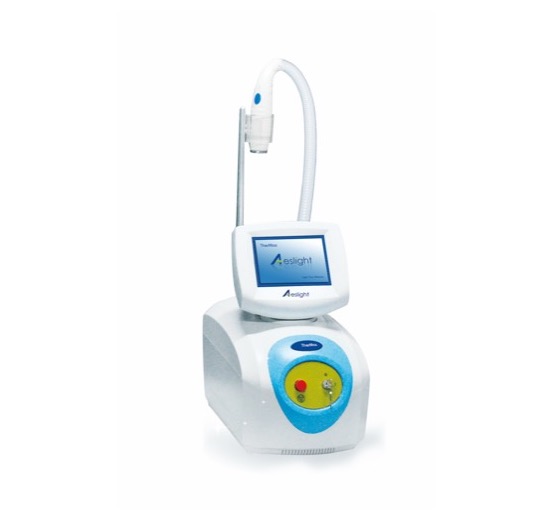
RF skin tightening works by delivering controlled radiofrequency energy into the dermis, heating tissue to 40–45°C. That heat denatures existing collagen fibers. It also triggers neocollagenesis — your body's natural wound-healing response. New collagen builds over weeks to months. The result? Gradual, real skin tightening. Not just a temporary plumping effect. For your clinic, the key buying decision is between mono and bipolar RF configurations. These directly affect treatment depth, pain profile, and session cadence.
You've probably heard "collagen remodeling" a hundred times from sales reps. Let's get specific about what actually happens inside the skin.
When RF energy passes through the dermis, it hits resistance from the tissue. That resistance — impedance — turns electrical energy into heat. At around 40°C, the hydrogen bonds holding collagen's triple-helix structure start breaking. The collagen fibrils unwind and contract. That's the immediate tightening your clients feel right after a session.
But the real value for your clinic comes next. The body treats that denatured collagen as damaged tissue. It sends fibroblasts to the area. Those fibroblasts lay down new collagen — neocollagenesis — over the following 8–12 weeks. This is why RF skin tightening isn't a one-and-done treatment. You're selling a biological process, not an instant result.
Per established tissue-heating science, the target range for non-ablative dermal remodeling is 40–45°C. Go below that and you get little to no collagen response. Push past 45°C and you risk thermal damage to the epidermis and surrounding structures. The margin is narrow. That's why machine precision matters more than power output.
This is the single most important technical decision you'll make when you buy an RF machine. The configuration determines your treatment depth, your patient comfort level, and how many sessions you'll need to promise.
Let's break it down.
One active electrode delivers the current. A large grounding pad (return electrode) completes the circuit somewhere else on the body. The current travels deep — up to 20mm or more — because it passes through the entire tissue layer between the two points.
Two electrodes are housed in the same handpiece. The current flows only between them — typically 2–4mm deep. The energy path is shallow and controlled.
| Feature | Monopolar RF | Bipolar RF |
|---|---|---|
| Treatment depth | Up to 20mm+ | 2–4mm |
| Ideal for | Moderate-severe laxity, jowls, body | Mild laxity, fine lines, eyes |
| Pain during treatment | Higher, often needs anesthetic | Low-moderate, usually no anesthetic |
| Typical session count | 1–2 per year | 6–12 per course |
| Burn risk | Arcing if pad fails | Lower, but still possible |
| Machine cost | Higher | Lower to mid-range |
Which should you buy? If your clinic targets high-end facial tightening and you have a medical director comfortable with deeper heating, monopolar is the gold standard. If you run a busy med-spa with a high volume of maintenance clients, bipolar gives you better session repeatability and lower risk per treatment. Many clinics carry both — the monopolar for initial courses, the bipolar for touch-ups.
RF skin tightening doesn't look like laser hair removal. You don't walk in, get zapped once, and walk out hair-free. It's a gradual process, and your clients need to understand that upfront.
Here's the honest timeline:
For monopolar RF, plan on 1–2 sessions total spaced 3–6 months apart. For bipolar, a typical course is 6–8 sessions weekly or bi-weekly. You can offer a package deal — it makes financial sense for both of you.
One more thing: don't promise "no downtime." Most clients will have mild erythema for 1–4 hours. Some monopolar patients get transient edema, especially around the jawline. It's not downtime like CO2 resurfacing, but it's not zero either. Be honest about it.
RF is versatile, but it's not for everyone. Here's your quick triage guide.
Good candidates:
Poor candidates:
If you're unsure, do a small test spot on the inner forearm. Wait 24 hours. Check for any adverse reaction. This is standard practice for any energy-based device.
You've read the theory. Now let's talk about the purchase. Here are the specs that actually matter:
Don't get distracted by "fractional RF" or "microneedling RF" — those are different technologies that combine RF with mechanical penetration. They're effective for acne scars and deeper remodeling, but they're not the same as standard RF skin tightening. Know what you're buying.
If you're comparing RF to other tightening modalities, you'll want to read our comparison of HIFU vs Thermage (RF) and our broader guide to skin laxity treatments compared.
One final thought: RF skin tightening is a reliable, evidence-based treatment that generates good revenue per session with low consumable costs. The machine pays for itself quickly if you build a proper treatment package. But the technology is only as good as the operator. Train your staff. Test your settings. And never, ever skip the test spot.
What is the difference between monopolar and bipolar RF for skin tightening?
Monopolar RF delivers energy deeper into the dermis and subcutaneous tissue. That makes it better for laxity on the face and body, but it's more painful and requires a grounding pad. Bipolar RF gives you shallower, more controlled penetration — ideal for delicate areas like periorbital skin. Less discomfort, and no grounding pad needed.
How long does it take to see results from RF skin tightening?
Results are gradual. You might notice some immediate tightening from collagen contraction, but the full effect develops over 2–6 months as neocollagenesis kicks in. Most protocols recommend 3–6 sessions spaced 2–4 weeks apart for optimal outcomes. Maintenance treatments every 6–12 months help sustain results.
Is RF skin tightening painful, and what anesthesia is needed?
Pain depends on the device and settings. Monopolar RF can cause significant heat sensation — often requiring topical anesthesia or nerve blocks. Bipolar RF is generally well-tolerated with just a warming sensation. Most patients describe it as a hot massage. No general anesthesia is needed, but cooling systems help minimize discomfort.
What skin types and areas are best suited for RF tightening?
RF is safe for all skin types, including darker skin, since it bypasses melanin absorption. It works well on the face, neck, abdomen, arms, and thighs. Best candidates have mild to moderate skin laxity. It's not a substitute for surgery in severe cases, but it's excellent for early sagging and as a maintenance treatment.
Every Pmise machine is verified through rigorous testing. Tell us your target treatments and market.