
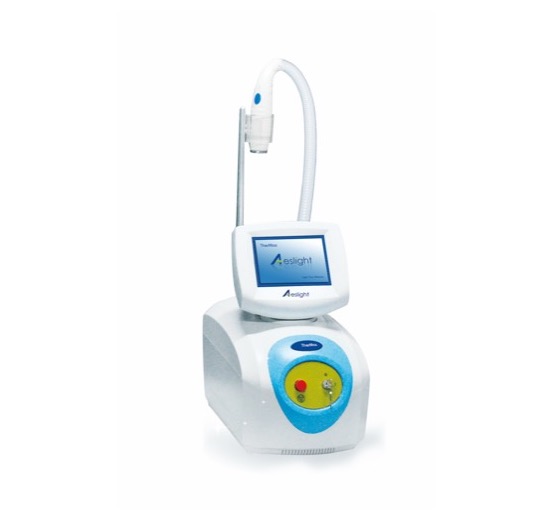
For most clinics, a multipolar rf skin tightening machine is the workhorse that balances safety, depth, and treatment speed. Monopolar gives you the deepest collagen remodelling—great for body contouring and lax skin. Bipolar stays superficial, ideal for delicate areas. And multipolar spreads heat more evenly, so you treat faster with less discomfort. Buy based on your primary indication, not on electrode count alone.
Every radio frequency skin tightening machine runs on the same physics. An alternating current passes through the skin. The tissue’s natural electrical resistance converts that current into heat—this is Joule heating, nothing more exotic. When the dermis reaches roughly 40–45°C, collagen fibres begin to denature and contract. Your patient doesn’t see this immediately. What happens over the next 4–12 weeks is the body’s wound-healing response: fibroblasts lay down fresh collagen, elastin fibres remodel, and the skin gradually tightens.
What separates a useful machine from a disappointing one is how that current is delivered. The electrode configuration—monopolar, bipolar, or multipolar—decides penetration depth, heat distribution, and how plush or prickly the treatment feels. Frequency matters too. Most professional devices operate between 0.5 MHz and 2 MHz. Per Pmise engineering documentation, the Pmise RF platform uses a 1 MHz carrier, which is a well-established sweet spot: deep enough to reach the reticular dermis, yet controllable enough to avoid excessive subcutaneous heating when the operator follows protocol.
Regulatory bodies treat these machines seriously. The FDA generally classifies RF aesthetic devices as Class II medical devices, meaning they require 510(k) clearance. In Europe, they fall under the Medical Device Regulation. And any reputable rf skin tightening machine should comply with IEC 60601-1 for electrical safety—this is basic; don’t skip it when shopping.
Monopolar is the original heavy lifter. You place a single active electrode on the treatment area and a large return pad elsewhere—usually on the patient’s back or thigh. The current arcs from the small handpiece through the entire body to the pad. Because the energy disperses over a huge distance, it heats the dermis and the fibrous septa of subcutaneous fat, reaching depths of 15–20 mm.
That’s a significant reach. If you’re treating a sagging jawline, postpartum abdomen, or upper arms, monopolar RF can remodel tissue where bipolar simply can’t go. The clinical mechanism is straightforward: controlled volumetric heating triggers collagen contraction and a subsequent repair cascade. There’s a reason early devices like Thermage built their reputation on monopolar technology.
The trade-offs? Treatment sensation. Patients feel a deep, intermittent heat spike. Effective coupling gel and a skilled hand are mandatory—bad technique leads to hot spots or burns. Also, a return pad isn’t always practical on bony or asymmetrical body zones. Still, for clinics that want one modality that does genuine lifting on both face and body, a monopolar-capable radio frequency skin tightening machine is hard to beat.
Bipolar RF puts both electrodes on the same handpiece, just a few millimetres apart. The current flows only between those two poles, so heating stays confined to roughly half the inter-electrode distance—typically 2–4 mm deep. That’s strictly dermal, which makes bipolar the go-to for thin skin zones: periorbital area, forehead, neck décolletage. It’s also the safest option when you’re treating close to bony prominences or post-inflammatory hyperpigmentation-prone skin.
Because the current path is so predictable, bipolar treatments feel more comfortable. No grounding pad, no deep visceral sensation. You’ll often see bipolar built into multifunction platforms—paired with IPL or vacuum for a “photorejuvenation plus tightening” add-on. The limitation is inherent: you won’t get jawline redefinition or submental fat tightening with a purely bipolar handpiece. It’s a superficial tool, and for many clinics it’s the complementary piece, not the main event.
Multipolar designs use three or more electrodes, and the current phase-shifts between them. This isn’t just three bipolar pairs glued together. By cycling which electrodes act as positive and negative poles, the device steers the heating zone deeper and wider than a single bipolar pair ever could—yet still avoids the deep, unpredictable current path of monopolar. A well-engineered multipolar handpiece can heat 10–15 mm thick tissue slabs with impressive uniformity.
For a busy clinic, that uniform heating translates into two things: faster treatment time and happier patients. You’re covering more surface area per pulse, and the heat builds gradually, so discomfort stays low. Combine multipolar RF with a vacuum mechanism—something you’ll see on Pmise RF body-contouring handpieces—and you also improve electrode-skin coupling, which makes energy delivery more efficient.
Does multipolar replace monopolar? Not quite. For stubborn laxity on the abdomen or inner thigh, the deepest monopolar reach still has an edge. But for a general aesthetic practice offering face and body tightening on the same platform, multipolar delivers the safest, most consistent results across a wide patient base. It’s why so many mid-range to high-end manufacturers now ship multipolar as their default RF technology.
| Feature | Monopolar | Bipolar | Multipolar |
|---|---|---|---|
| Penetration depth | 15–20 mm | 2–4 mm | 6–15 mm (design-dependent) |
| Grounding pad | Required | None | None |
| Comfort | Moderate to intense deep heat | Mild warmth | Mild to moderate, even warmth |
| Best for | Body contouring, facial lifting | Periorbital, delicate zones | Face and body tightening, faster sessions |
| Risk profile | Higher without proper training | Very low | Low |
| Typical session time (face) | 20–30 min | 15–25 min | 10–20 min |
Don’t start with electrode count. Start with the indication you’ll treat most. If your menu is 80% facial, a bipolar or multipolar handpiece with a small spot size suits you. If you plan to offer body contouring alongside HIFU or cryolipolysis, demand a machine that can run both multipolar body applicators and a monopolar option—modular platforms exist for this reason.
Next, check the engineering, not the brochure claims. A quality radio frequency skin tightening machine will give you real-time impedance monitoring. The power output should adapt when the tissue heats up; otherwise you’ll under-treat or over-treat as impedance drops. Ask the manufacturer: does the handpiece thermistor provide closed-loop feedback? If the answer is vague, walk away.
Cooling matters more than most buyers realise. Contact cooling—a sapphire or ceramic tip chilled to around 5°C—protects the epidermis and lets you push energy higher without surface burns. Air cooling alone rarely cuts it for aggressive protocols. Check the cooling method on the body applicators too. A 40-minute abdomen treatment needs steady thermal management.
Finally, look at serviceability and certifications. The machine should carry a valid CE mark under the Medical Device Regulation and be manufactured under ISO 13485 quality systems. If you’re purchasing for a North American clinic, confirm FDA 510(k) registration. These aren’t expensive stickers; they’re your liability shield. Also ask about spare handpiece availability—RF electrodes degrade with use, and you don’t want a six-month wait for a replacement.
If you’re building a combination therapy room, consider platforms that share one base unit with different handpieces. For instance, a machine that runs RF alongside vacuum-assisted body work or LED phototherapy can increase patient throughput without doubling your equipment spend. Just be certain the base station power supply can deliver rated energy to all handpieces simultaneously—some consolidated systems throttle output when more than one applicator is connected.
Where does HIFU fit in? HIFU focuses ultrasound at precise depths, hitting the SMAS layer for lifting, while RF heats volumetrically. They’re complementary, not interchangeable. Clinics that offer both can address superficial dermal laxity with RF and deeper structural sagging with HIFU. If you already own a HIFU machine, a multipolar RF adds a gentler, faster tightening option for patients who aren’t ready for the commitment—or discomfort—of HIFU sessions.
At the end of the day, the right rf skin tightening machine is the one that matches your clinical reality, not your competitor’s feature list. Choose the electrode configuration based on depth, choose the build based on compliance and serviceability, and don’t let electrode-count marketing blur the physics. Heat is heat—it’s the control of that heat that pays off.
Ready to match the right technology to your treatment menu? Explore the Pmise RF platform or request a consultation from our engineering team.
Which RF technology is best for body contouring and skin laxity?
Monopolar RF provides the deepest energy penetration, stimulating collagen remodelling in the deep dermis and subcutis. This makes it the preferred choice for body contouring and treating significant skin laxity, offering results that are more pronounced than superficial treatments. Clinics focusing on body treatments should prioritize monopolar devices.
What type of RF machine is safest for delicate facial areas?
Bipolar RF stays superficial, making it safer for delicate areas like the face where you want to avoid deep tissue heating. It limits penetration to the skin's upper layers, reducing risk of burns or discomfort. For sensitive facial skin, bipolar is the appropriate choice.
Why do many clinics use multipolar RF machines as their primary device?
Multipolar RF balances safety, depth, and treatment speed by spreading heat more evenly. This reduces discomfort and allows faster treatments compared to monopolar or bipolar alone. It's versatile for various indications, making it a practical workhorse for clinics that need efficiency across multiple treatment types.
Should I base my purchase decision on the electrode count of the machine?
No, the article advises buying based on your primary indication, not electrode count alone. Monopolar, bipolar, and multipolar each have specific strengths for depth or surface treatment. Match the technology to your most common procedures—body contouring, facial rejuvenation, or speed—to ensure optimal clinical outcomes.
Every Pmise machine is verified through rigorous testing. Tell us your target treatments and market.