
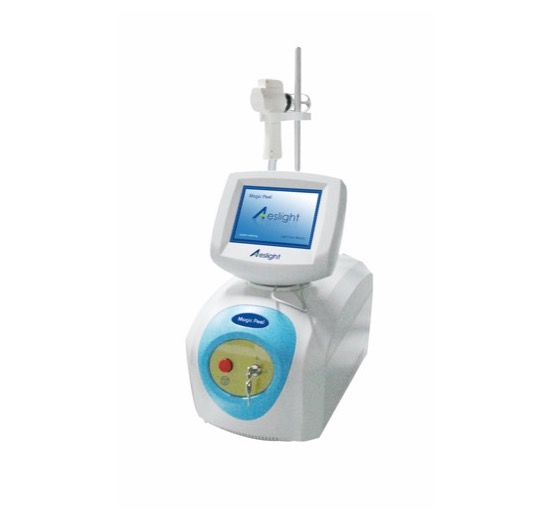
Does your clinic treat patients with Fitzpatrick IV-VI skin? Or maybe you have clients who flat-out refuse any visible downtime. If so, the 1550nm fractional laser is your safest resurfacing tool. It's non-ablative. That means it leaves the epidermis intact while building collagen in the dermis. You get a real trade-off though. You'll need 3-5 sessions where an ablative CO2 might do it in 1-2. So it's a volume play, not a quick-results machine.
A 1550nm erbium glass laser creates microscopic thermal zones (MTZs) in the dermis. It does this without vaporizing the top layer of skin. That's the core difference from an ablative laser like fractional CO2. Your epidermis stays intact, acting as a natural bandage. For certain patient profiles, this matters more than the sticker price.
The wavelength itself is the reason. At 1550nm, water absorption is strong enough to heat tissue to collagen-denaturing temperature. But it's not so aggressive that it blows off the epidermis. Per the YILIYA-1550A manual, the system emits at 1550nm with a pulse energy range that creates controlled thermal injury zones. They're roughly 100-200 microns deep. That's deep enough to stimulate new collagen, yet shallow enough to heal fast. You get the picture.
Key parameters from the manufacturer specifications:
You'll see this laser marketed as "fractional non-ablative," "erbium glass," or simply "1550 fractional." They're the same thing. Don't confuse it with 2940nm Er:YAG — that's ablative and targets different tissue.
This is the main reason clinics buy a 1550nm system. For Fitzpatrick IV, V, and VI, ablative lasers carry a real risk. Post-inflammatory hyperpigmentation (PIH) is common. The non-ablative approach dramatically lowers that risk. Why? Because you're not wounding the melanin-rich epidermis. The manual explicitly lists contraindications for active infections and photosensitivity. But darker skin types? They're a primary target user, not a contraindication.
Think of a busy med-spa in a diverse urban market. You'll see South Asian, Middle Eastern, and African-descent clients walk in. They want acne scars or texture improvement. A CO2 laser on that skin is a gamble you probably don't want to take. The 1550nm gives you a safe option you can run every 3-4 weeks. No worrying about prolonged downtime or pigmentation backlash.
Some patients literally cannot take a week off. Executives, public-facing professionals, people with social media careers. For them, "healing" means redness that fades in 1-3 days. Not oozing and crusting. The 1550nm delivers that. Your skin feels like a mild sunburn for 24-48 hours, then you're back. You trade dramatic single-session results for a predictable, low-risk course of treatments. Fair trade?
The 1550nm is clinically established for rolling and boxcar scars — the types that don't require tissue ablation. Deep ice-pick scars? You'll get better results with a CO2 laser for acne scars or punch excision. But for diffuse texture loss, enlarged pores, and mild scarring, the 1550nm is a workhorse. You're building collagen slowly over months. The results are subtle but cumulative.
Don't expect a facelift. But the thermal effect in the dermis does tighten collagen fibers. It's a secondary outcome, not the primary reason to buy. If your clinic already offers HIFU or RF skin tightening, the 1550nm complements those treatments rather than replacing them. You can bundle them — RF for bulk tightening, 1550nm for texture and fine lines.
Let's be direct. If your clinic is in a market where patients expect dramatic, visible results after one session, the 1550nm will frustrate them. They'll compare it to CO2 results and feel shortchanged. You need to educate them upfront about the session count.
Also: if you're treating deep wrinkles or significant photodamage, the 1550nm is underpowered. You need ablative resurfacing for that. The non-ablative approach simply doesn't remove enough tissue to remodel deep rhytids. Stick with CO2 or Er:YAG for those cases.
Specific contraindications from the manual include:
These are common to most resurfacing lasers, but worth repeating because the 1550nm's safety profile can make clinics complacent. It's still a Class 4 laser. Respect it.
| Parameter | 1550nm Er:Glass (Non-Ablative) | CO2 10600nm (Ablative) | Er:YAG 2940nm (Ablative) |
|---|---|---|---|
| Epidermis removed? | No | Yes | Yes |
| Downtime | 1-3 days redness | 5-10 days crusting | 3-7 days |
| Safe for Fitzpatrick IV-VI? | Yes (first choice) | High PIH risk | Moderate risk |
| Sessions for acne scars | 3-5 | 1-2 | 2-3 |
| Collagen stimulation | Moderate, cumulative | Strong, immediate | Moderate |
| Pain level | Moderate (needs topical anesthetic) | High (needs nerve block/sedation) | Moderate-high |
Notice the pattern. The 1550nm trades depth for safety. It's not "better" or "worse" than CO2 — it's a different tool for a different patient. A smart clinic owns both. The 1550nm fractional laser handles your darker skin and downtime-averse clients, while the fractional CO2 takes care of the heavy lifting.
The YILIYA-1550A offers three zoom lens settings: 8×8, 16×16, and 30×30 mm. For a full-face treatment, you want the larger spot size. It keeps session time under 30 minutes. Smaller spots are useful for periorbital or localized scar work. Check that the system you're evaluating has adjustable spot sizes — some cheap imports lock you into one fixed size, which kills throughput.
Non-ablative doesn't mean painless. The 1550nm heats dermal tissue to 60-70°C. Without adequate skin cooling, patients won't tolerate it. The manual recommends topical anesthetic plus contact cooling. Some systems integrate a sapphire cooling tip; others rely on forced air. Test the cooling system before buying. If it's weak, your chair turnover drops.
The 1550nm laser is a medical device in most regulated markets. You need CE marking under the Medical Device Regulation for Europe, and FDA clearance for the US market. The YILIYA-1550A manual is clear about its Class 4 laser classification under IEC 60825. Don't buy from a supplier who can't provide these documents. ISO 13485 certification for the manufacturer is a minimum requirement — it tells you their quality management system is audited.
Here's the math that matters. If you charge $300-500 per session for a 1550nm facial, and you sell a package of 5 sessions, that's $1500-2500 per client. Compare that to one CO2 session at $1500-2500. The revenue per client is similar, but the 1550nm client comes back 5 times — that's 5 opportunities to upsell products, other treatments, or maintenance. The lifetime value is often higher. Plus, your risk of complications is lower, which means fewer refunds and complaints.
That's why the 1550nm fractional laser is a smart addition to a clinic's lineup, not a compromise. It fills a gap that ablative lasers can't touch safely. If your patient demographic includes darker skin types or busy professionals, you're leaving money on the table without it.
How many sessions of 1550nm fractional laser are typically needed for skin resurfacing?
Most patients require 3 to 5 sessions spaced 4 weeks apart. That's more than ablative lasers like CO2, which may need only 1-2 sessions. But the trade-off? Minimal downtime and lower risk for darker skin types. You'll see it pay off over time.
Is the 1550nm fractional laser safe for darker skin tones like Fitzpatrick IV-VI?
Yes, it is considered one of the safest resurfacing options for Fitzpatrick IV-VI skin. Because it's non-ablative and leaves the epidermis intact, the risk of post-inflammatory hyperpigmentation is significantly lower compared to ablative lasers. Your darker-skin clients will thank you.
What downtime can a patient expect after a 1550nm fractional laser treatment?
Downtime is minimal. Patients typically experience mild redness and swelling for 1-3 days, with some bronzing or flaking for up to a week. Most can return to work the next day with makeup. That's unlike ablative lasers which require 1-2 weeks of recovery.
What skin concerns does the 1550nm fractional laser treat best?
It is most effective for improving skin texture, fine lines, mild to moderate acne scars, and photodamage. It builds collagen gradually over multiple sessions, so it is ideal for patients seeking subtle, cumulative improvements without the downtime of ablative treatments. Your clinic can count on repeat visits.
Every Pmise machine is verified through rigorous testing. Tell us your target treatments and market.