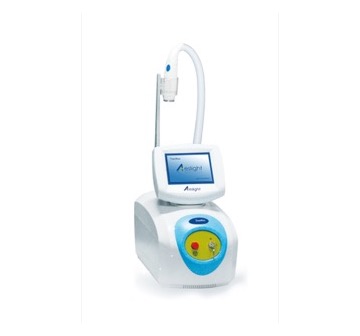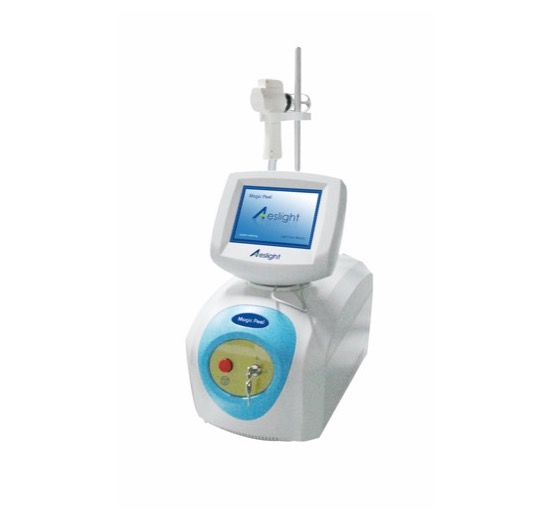
The 1550nm erbium glass fractional laser is a non-ablative skin resurfacing machine that scans microscopic laser columns into the dermis, where water absorbs the energy and triggers new collagen growth. It treats acne scars, wrinkles, stretch marks and enlarged pores on all skin types, with nearly no pain and no downtime.
Pmise-G01
A 1550nm erbium glass fractional laser is a non-ablative acne scar laser and skin resurfacing platform that delivers fractional infrared energy into the dermis without breaking the skin surface. The Pmise-G01 builds this technology around an erbium glass fiber laser of up to 30W and a computer pattern generator that scans 50um-80um micro spots in randomized patterns. Because the target chromophore is water rather than melanin, it treats acne scars, wrinkles, stretch marks and enlarged pores on all Fitzpatrick skin types. It suits dermatology clinics and medical spas that want resurfacing results without the recovery time of ablative lasers, salons that need a low-complication entry into laser skin treatments, and distributors looking for a compact, air-cooled system that is easy to demonstrate and support.
The 1550nm erbium glass fractional laser resurfaces skin by fractional photothermolysis: thousands of microscopic laser spots heat columns of dermal tissue while the skin between them stays untouched, so the epidermis remains intact and healing is fast. The system adopts a 1550nm fiber laser and a computer pattern generator (CPG) arranged in matrix scanning output, emitting a 50um-80um spot through a high focusing lens. The target tissue is water in the dermis, forming matrix-like micro holes of about 0.12mm around the focal spot, with a penetration depth of about 2mm.
The normal tissue surrounding each tiny hole generates a heat bridge that starts the wound rehabilitation reaction between the epidermis and dermal tissue, passing through the inflammation, proliferation and remodeling phases. Fibroblasts in the dermal layer multiply significantly within days, and after about fifteen days collagen synthesis increases and thickens the dermis - which is why skin texture, elasticity and scar appearance keep improving for weeks after each session. Because heat energy, not tissue removal, drives the result, this approach is far gentler than ablative resurfacing with a CO2 fractional laser machine, at the cost of a milder single-session effect.
For epidermal pigmented lesions and tattoos, a Q-switched ND:Yag laser is the more suitable tool; for pure skin tightening without resurfacing, see our RF skin tightening machine.
Max. 30W fiber laser power output with min. 50um focal spot size and penetration up to 2mm creates excellent clinical effect with nearly no pain and complications.
Because the target tissue is water, there is no skin type limit (Fitzpatrick I-VI); treatment is almost non-invasive to the skin with no downtime.
Randomized CPG scanning avoids thermal damage caused by heat accumulation, reducing the pain of the treatment.
Three kinds of treatment spot lenses are available: a fixed-focal lens for the deepest, smallest spot; an adjustable-focal (zoom) lens for free control of deep or shallow treatment; and a roller-type fixed-focal lens designed for the orbital, perioral and nose wing areas.
Focal spot density, quantity, scanning pattern and area are all adjustable, so the doctor can match the treatment precisely to different body parts and patient demands.
10W, 20W and 30W laser power versions are available for different clinical demands.
All three wavelengths resurface skin by stimulating collagen renewal, but they differ sharply in aggressiveness and recovery. The table below shows how this non-ablative 1550nm platform compares with the two ablative options in the Pmise range.
| Technology | Best for | Depth / wavelength | Downtime | Suitable buyer |
| 1550nm Erbium Glass (this page) | Acne scars, stretch marks, enlarged pores and fine lines on all skin types | 1550nm, non-ablative, dermal penetration up to about 2mm | Nearly none - daily life is not interrupted | Clinics, medical spas and salons whose clients cannot accept recovery time, including darker skin types |
| Fractional CO2 laser | Deep scars, heavy photoaging and the strongest single-session resurfacing | 10600nm, ablative - vaporizes micro columns of tissue | Days of visible recovery | Dermatology clinics that manage medical-grade aftercare |
| Er:YAG 2940nm laser | Precise ablative resurfacing with less residual heat than CO2 | 2940nm, ablative, strongly absorbed by water near the surface | Shorter than CO2, longer than 1550nm | Clinics that want ablative results with faster healing |
Dermatology clinics: the 30W version treats deep atrophic scars and stretch marks efficiently, and the three interchangeable lens types (fixed-focal, zoom and roller) let one platform cover face, body and delicate periorbital areas. Many clinics run the Pmise-G01 alongside a CO2 platform, offering patients both an ablative and a no-downtime pathway.
Medical spas and beauty salons: because treatment is nearly painless with no downtime, the machine fits membership-style repeat business. The 10W or 20W versions keep the investment lower for salons focused on pores, fine lines and skin rejuvenation, and air cooling means there is no water circuit to maintain.
Distributors: one platform with three power versions covers several price points, the all-fiber beam delivery is robust in shipping and demonstration, and the dual-voltage power supply (220V and 110V) simplifies stocking for different markets.
| Pmise-G01 | |
| Laser Type | Erbium Glass Fiber Laser |
| Wavelength | 1550nm |
| Laser Power | 30W (10W, 20W optional) |
| Output Mode | Fractional (CPG) |
| Pulse Energy | 10mJ-200mJ (step 2mJ) |
| Pulse Width | 0.067ms-6.7ms |
| Spot Diameter | 50um-2000um (continuously adjustable) |
| Scanning Mode | Random CPG scanning |
| Scan Pattern | Triangle / Square / Rectangle / Rhombus / Round (upgradeable to DIY graphics) |
| Spot Density | 6x6, 12x12, 24x24 spots/cm2 |
| Scan Area | 1x1cm2, 2x2cm2, 3x3cm2 |
| Pulse Interval | 1ms-100ms (step 1ms) |
| Aiming Beam | 635nm, ≤5mW |
| Guide Light System | Fiber |
| Cooling | Air cooling |
| Fuse | Max 5A |
| Power Supply | AC 220V±10%, 50Hz; AC 110V±10%, 60Hz |
Get factory price and full technical specifications for Pmise-G01 ›
Pmise machines are exported to America, Europe, the Middle East, Africa and Southeast Asia, and every order is backed by the same factory service commitments:
A 1550nm erbium glass fractional laser is a non-ablative skin resurfacing device. Its fiber laser targets water in the dermis, creating microscopic thermal columns that trigger new collagen production without removing the skin surface. It is used to treat acne scars, wrinkles, stretch marks and enlarged pores with minimal downtime.
Discomfort is low compared with ablative lasers. The 50-80 micron micro spots leave the surrounding skin intact, and randomized scanning prevents heat from accumulating in one area. Most patients describe a warm, prickling sensation, and because the treatment is almost non-invasive to the skin, normal work and daily life are not interrupted.
Yes. The laser's target chromophore is water rather than melanin, so all Fitzpatrick skin types I-VI can be treated. Because the epidermis is not removed, the risk of post-treatment pigmentation problems is much lower than with ablative resurfacing, which makes 1550nm fractional treatment a preferred option for Asian and darker skin.
A CO2 fractional laser (10600nm) is ablative: it vaporizes micro columns of tissue for stronger resurfacing but needs a longer recovery period. The 1550nm erbium glass laser is non-ablative: it heats the dermis while keeping the epidermis intact, giving gentler treatment, less downtime and a lower complication risk. Many clinics operate both platforms.
Collagen regeneration is a gradual process that generally takes several weeks after each treatment, so improvement builds progressively. A course of several sessions is usually scheduled, spaced to let the dermis remodel between visits. Deeper concerns such as acne scars and stretch marks typically need more sessions than fine lines or enlarged pores.
The price depends mainly on the fiber laser power you choose: 10W, 20W and 30W versions are available for different clinical demands, and the selection of treatment lenses also affects the configuration. As a factory supplier, Pmise quotes directly without middlemen - send an inquiry through the contact form on this page for a detailed quotation.
Every Pmise-G01 comes with a one-year warranty from the date you sign for the machine, plus lifetime maintenance afterwards. Technical consulting is answered within 30 minutes, and door-to-door service is arranged at least twice a year, so your clinic keeps running without long interruptions.
Choose the 10W or 20W version if your salon mainly treats fine lines, enlarged pores and mild acne scars with moderate client flow. The 30W version delivers energy faster and handles deep atrophic scars and stretch marks more efficiently, so busy clinics and dermatology practices usually select it.
Treatment results vary by skin type, indication and operator settings. Professional operator training is required before clinical use.
Every Pmise machine is verified through rigorous testing. Tell us your target treatments and market.