
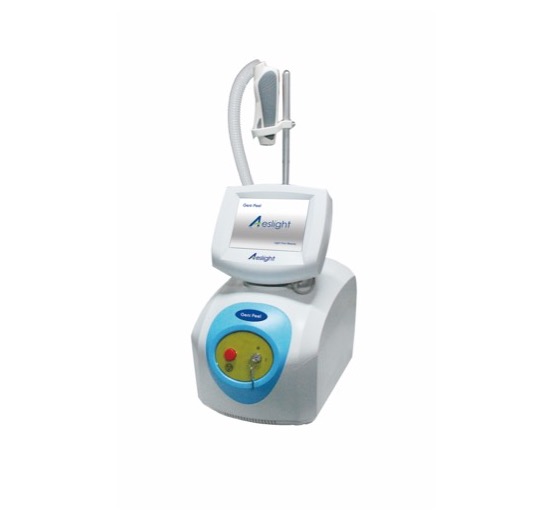
If you're choosing between a CO₂ laser and an Er:YAG 2940nm for your clinic, the short answer is this: CO₂ delivers deeper ablation and stronger coagulation for heavy resurfacing and scarring, while Er:YAG offers shallower, more precise ablation with faster healing. Your choice depends on whether you prioritize treatment depth or downtime — and many clinics stock both.
The fundamental difference between these two lasers isn't brand or price — it's how they interact with water. Both target water as their chromophore, but the absorption coefficients are worlds apart.
Er:YAG at 2940nm hits a water absorption peak roughly 10 to 15 times higher than CO₂ at 10600nm. That sounds like Er:YAG would be the stronger laser, right? Not exactly. Here's why.
When Er:YAG energy hits the skin, it's absorbed so aggressively that it vaporizes tissue in an extremely thin layer — typically 2–4 microns per joule per manufacturer specifications. The energy doesn't penetrate deeper because the water in the superficial tissue soaks it up almost instantly. You get clean, precise ablation with minimal residual heat.
CO₂ laser energy, by contrast, is absorbed less aggressively by water. That means it penetrates deeper into the dermis before it's fully absorbed. The result: more thermal coagulation — typically 100–200 microns of coagulated tissue beneath the ablated zone. This coagulated layer drives collagen remodeling, which is why CO₂ is the gold standard for treating deep acne scars and photoaging.
So the mechanism trade-off is clear. Er:YAG = precision ablation, less heat. CO₂ = deeper effect, more coagulation. Neither is "better" — they're different tools.
| Property | CO₂ (10600nm) | Er:YAG (2940nm) |
|---|---|---|
| Ablation depth per pass | 20–60 microns | 2–4 microns per J/cm² |
| Coagulation zone | 100–200 microns | Minimal (5–15 microns) |
| Collagen tightening | Strong (heat-dependent) | Moderate (requires multiple passes) |
| Bleeding during treatment | Minimal (coagulation seals vessels) | More pinpoint bleeding possible |
| Typical downtime | 5–14 days | 3–7 days |
These numbers come from established laser-tissue interaction physics, confirmed by decades of clinical use. Your buying decision should start here.
For a busy clinic, the practical difference matters most in two areas: how many sessions you'll need for a given condition, and how much downtime your clients can tolerate.
Let's be blunt: CO₂ downtime scares some clinic owners, but it also justifies higher per-session pricing. Er:YAG downtime is shorter, but you'll need more sessions to match CO₂ results for deep indications.
For CO₂ fractional treatments, the epidermis typically re-epithelializes in 5–7 days, but redness (erythema) can persist for 2–4 months. That's not a small thing. Your consent forms need to be explicit. The Laser Skin Resurfacing Aftercare protocol should be followed strictly.
Er:YAG fractional treatments see re-epithelialization in 3–5 days, with erythema fading in 1–3 weeks. But here's the catch: if you push Er:YAG aggressively (high fluence, multiple passes), you can create deeper ablation that approaches CO₂-level downtime. You're trading precision for depth.
Both lasers require proper eye protection per IEC 60825. Your treatment room must have wavelength-specific eyewear for both the patient and operator. This isn't negotiable.
Let's map specific conditions to the better tool. This isn't theoretical — it's what we see clinics doing successfully.
Both lasers have well-established FDA clearances for skin resurfacing. The FDA clears fractional CO₂ for treatment of periorbital wrinkles and resurfacing, and Er:YAG for similar indications. But here's a practical point: many clinics use these lasers off-label for conditions like acne scars and stretch marks. That's common in aesthetic medicine, but your liability and consent practices should reflect it.
CE marking under the Medical Device Regulation requires both devices to meet essential safety and performance requirements. Neither technology is inherently "safer" — it's about how you use it.
You'll find that Er:YAG lasers are generally less expensive to manufacture because the laser medium (erbium-doped crystal) is simpler to pump than the CO₂ gas mixture with RF excitation. But that doesn't always translate to your purchase price — brand, fractional handpiece quality, and pulse engineering matter more.
CO₂ lasers require periodic gas refills or tube replacement. The RF-Excited vs Glass Tube CO2 Laser comparison covers this in depth. RF-excited tubes can last 10,000+ hours; glass tubes are cheaper but need replacement sooner. Er:YAG flashlamps typically need replacement every 300,000–500,000 pulses, depending on the manufacturer's design.
Neither machine is cheap to maintain if you neglect it. Factor in annual calibration and cooling system checks. Your Beauty Machine Warranty & After-Sales questions should include tube/lamp replacement costs upfront.
Here's a plain-spoken framework. Answer these three questions honestly:
If your budget allows, buy both. They're complementary, not competitive. The combined approach — Er:YAG for precise ablation followed by CO₂ for thermal tightening — is a protocol that serious resurfacing clinics use to get results neither can achieve alone.
For a deeper dive into CO₂ specifically, read the CO2 Laser for Acne Scars guide. For Er:YAG protocols, the 2940nm Er:YAG Fractional Laser product page has detailed parameter tables.
Which laser is better for deep acne scars: CO2 or Er:YAG?
CO2 laser is generally preferred for deep acne scars because it penetrates deeper into the dermis (up to 500-600 microns) and produces stronger coagulation, which stimulates more collagen remodeling. Er:YAG is shallower (typically 5-50 microns per pass) and better for superficial texture. For severe scarring, CO2 offers more dramatic results.
How does downtime compare between fractional CO2 and Er:YAG 2940nm?
Er:YAG typically has shorter downtime because it causes less thermal damage — healing often takes 3-5 days with mild redness. Fractional CO2 causes more coagulation and deeper tissue effects, so downtime is usually 5-10 days with more pronounced swelling, oozing, and prolonged redness. Patients should plan for a longer recovery with CO2.
Can I use one laser for both resurfacing and tightening, or do I need both?
Fractional CO2 is better for combined resurfacing and tightening due to its deeper thermal effect (up to 500 microns) and strong coagulation, which contracts collagen. Er:YAG is primarily ablative with minimal tightening. If you want to offer both heavy resurfacing and precise superficial treatments with fast healing, stocking both lasers is common in high-volume clinics.
What about safety for darker skin types: CO2 or Er:YAG?
Er:YAG is generally safer for darker skin (Fitzpatrick IV-VI) because its shallow ablation and minimal thermal spread reduce the risk of post-inflammatory hyperpigmentation. Fractional CO2 has higher risk of dyspigmentation in darker skin, though using low-density settings can mitigate this. Always test on a small area first.
Every Pmise machine is verified through rigorous testing. Tell us your target treatments and market.