
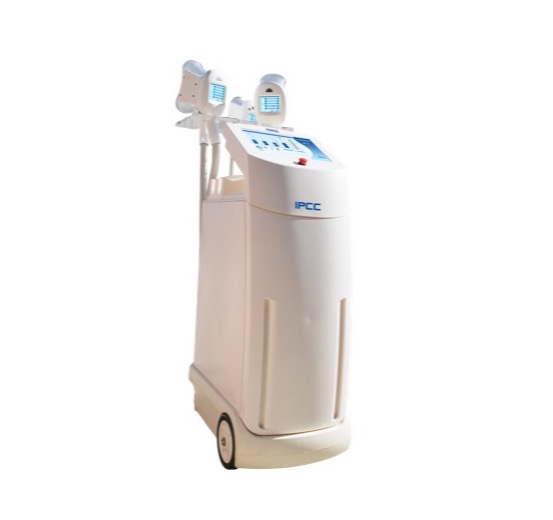
A cryolipolysis machine kills fat cells by controlled cooling — no needles, no downtime. The technology, called cold-induced apoptosis, selectively crystallises lipids in fat tissue while leaving skin, nerves, and muscle unharmed. For a clinic, the real buying decision isn't about whether the tech works; it's about applicator design, cycle speed, and safety certifications. Here's what you actually need to know before writing a cheque. Often marketed as a fat freezing machine, its cryolipolysis machine price tracks applicator count and build quality far more than brand name.
You've probably heard the phrase "fat freezing" a thousand times. But here's the mechanism your technician needs to understand.
Adipocytes — fat cells — have a higher lipid content than surrounding cells. Lipids crystallise at a higher temperature than water-rich tissue. When you apply controlled cooling (typically −5°C to −10°C at the applicator surface, per manufacturer specifications), the fat cells undergo crystallisation first. The surrounding skin and muscle stay above their freezing threshold because their water content buffers them.
Once crystallised, the fat cell triggers its own death — apoptosis. This isn't necrosis; there's no inflammatory explosion. The cell quietly breaks down over weeks, and macrophages clear the debris via the lymphatic system. That's why you don't see results the next day. You'll start noticing changes around three to four weeks post-treatment, with the final outcome visible at two to three months.
This timeline matters when you're setting client expectations. A client who expects a "fat freeze and done" in a week will be disappointed. One who understands the biological clock? They'll rebook.
Not all cryolipolysis applicators are the same. In fact, this is the single biggest differentiator between a machine that delivers consistent results and one that causes headaches.
There are two main designs:
Your choice depends on your client base. A busy salon running back-to-back sessions on younger clients might prefer vacuum applicators for speed. A med-spa treating older or thinner clients should lean toward flat-plate designs to reduce adverse events.
One practical observation from the shop floor: vacuum applicators that don't have a real-time pressure sensor are a liability. If the machine can't detect when suction is too high for that particular client, you're guessing. And guessing leads to paradoxical adipose hyperplasia (PAH) — a rare but real complication where fat cells actually grow instead of shrink. It's not common, but it's a lawsuit risk. More on that in our dedicated guide on cryolipolysis safety and PAH prevention.
Let's walk through a typical session. This isn't theory — it's what your staff will do eight times a day.
The machine's software should log cycle time, temperature curve, and vacuum pressure for each session. If it doesn't, you're flying blind when a client questions their outcome.
Here's the honest conversation you need to have before the first cycle:
| Timeframe | What happens | What the client sees |
|---|---|---|
| Immediately | Area is cold, numb, may look red or swollen | Nothing — just temporary redness |
| 1–3 weeks | Apoptosis is underway; macrophages clearing debris | Subtle or no visible change |
| 4–8 weeks | Fat layer visibly thins | Clear reduction in pinchable fat |
| 2–3 months | Final result stabilises | Full effect visible |
One session typically reduces fat thickness by 20–25% in the treated area. That's not a number we invented — it's the range cited across clinical literature for well-executed cryolipolysis. Multiple sessions (spaced 6–8 weeks apart) can achieve more, but you're looking at diminishing returns after the third round on the same area.
Your job as a clinic owner is to under-promise and over-deliver. Tell them: "You'll see a change, but it won't be dramatic after one session. Most clients need two to three for the look they want." That's honest, and it builds trust.
You're buying a medical device, not a kitchen appliance. The safety paperwork matters more than the sticker price.
A legitimate cryolipolysis machine should carry:
As a historical reference, earlier devices from the HONKON archive (circa 2012) were tested under EN 60335-1 for electrical safety. Modern equivalents should meet the same standard or better. Don't accept a "CE" sticker without the supporting test report.
For a deeper dive on the certification landscape, read our guide on CE marking for beauty machines and ISO 13485 explained for device buyers.
You're probably also looking at ultrasonic cavitation or RF-based slimming. Here's the short version:
Most clinics that do well with body contouring offer at least two modalities. Cryolipolysis for the stubborn belly fat and love handles; cavitation for the thighs and arms. You can read a full comparison in our article on cavitation vs cryolipolysis.
And if you're working out the business side — pricing per session, ROI, package structure — we've covered that in body contouring business ROI.
When you're evaluating a cryolipolysis machine, don't get distracted by the touchscreen or the marketing claims. Check these three things:
Cryolipolysis is a proven technology — the FDA cleared it for fat reduction in 2010, and it's been refined since. But the machine you choose determines whether that technology delivers in your clinic. Choose based on build quality, not price. Your clients' results — and your reputation — depend on it.
How many cycles can a cryolipolysis machine run per day?
It really depends on the compressor and cooling system inside the box. Most clinical-grade units manage 6–10 cycles daily with proper cooldown intervals. High-end models with dual compressors? You might push 15 cycles. Always check the manufacturer's duty cycle rating — skip that, and you risk overheating and inconsistent cooling.
What applicator shapes are available and which one do I need?
You'll find flat, curved, and vacuum-based cups. Flat ones work for the abdomen and thighs; curved ones fit arms and flanks; vacuum cups handle pinchable fat. Some machines offer adjustable heads. Pick based on the areas you treat most often — versatility costs more upfront but usually pays off in ROI.
What safety certifications should I look for?
At minimum, look for FDA clearance (510(k) or De Novo) and CE marking. In the US, FDA clearance confirms the device is safe and effective for fat reduction. CE marking indicates compliance with EU health and safety standards. Also check ISO 13485 for manufacturing quality. Avoid machines without these certifications — they may pose risks and won't pass insurance audits.
How long does a typical treatment session take?
A single applicator cycle usually lasts 35–60 minutes, depending on the target area and cooling intensity. Some newer machines offer dual applicators to treat two areas simultaneously, cutting total session time in half. Factor in 10–15 minutes for patient setup and post-treatment massage. Most clinics schedule 60–90 minute appointments per patient.
Every Pmise machine is verified through rigorous testing. Tell us your target treatments and market.